REGULATION news: President of European Central Bank: “Not Within Our Power to Prohibit or Regulate Bitcoin”
The president of the European Central Bank (ECB), Mario Draghi, has stated that bitcoin does not fall under the regulatory powers of the ECB. The statement was made in response to a question from the Committee on Economic and Monetary Affairs of the European Parliament.
“It Would Not Be [Within] Our Power to Prohibit or Regulate [Bitcoin]” – Mario Draghi, President of the European Central Bank
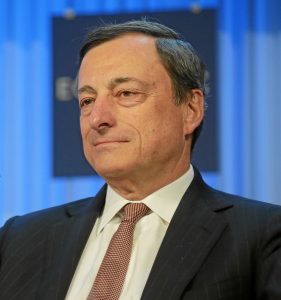
Mario Draghi reportedly made the statement following a question from the European Parliament’s Committee on Economic and Monetary Affairs regarding whether or not the ECB plans to develop a regulatory apparatus pertaining to bitcoin, and what risks cryptocurrencies may pose to the European economy.
According to a Google translation of a story posted by Eunews.it, Draghi stated that after considering “the magnitude, user acceptance and impact on the real economy [of bitcoin]…it would be very premature to consider it as a payment instrument for the future”. The ECB president stated that the ECB “has not yet had a discussion” regarding the topic, adding that “it would not be [within] our power to prohibit or regulate [bitcoin]”. Draghi also expressed the ECB’s intention to assess the cyber risks associated with bitcoin and cryptocurrencies.
Draghi’s Statements Echo Those Made Regarding Blockchain Technology During an Event at Trinity College in Dublin

During a Youth Dialogue event at Trinity College in Dublin, the ECB president answered a question on whether “new technologies, specifically blockchain, have a role in monetary policy [in] the future.” Draghi responded “we at the ECB are looking into this, and we have now been looking at this for some time. One conclusion is that, at this point in time, the technology is not mature [enough] yet… to be considered in either central bank policy-making, or in the payments system. We have to look at what progress this technology will [make] in the future.”
At both events, the ECB president emphasized the European Central Bank’s desire to assess the cyber risks associated with new technologies. At Trinity College in Dublin, Draghi described “cyber risk” as the “dominant [issue] today” in the “realm of digitalization.” He added that “any innovation, like [blockchain], will be screened from [the] viewpoint [of] how much our exposure to cyber risk is going to go up because we embrace a new technology.”
The ECB president recently rejected Estonia’s plans to launch a state-backed national cryptocurrency, stating that under EU law “no member state can introduce its own currency. The currency of the eurozone is the euro.” Earlier this week, ECB vice-president, Vitor Constancio, compared bitcoin to the “tulipmania” that swept across the Netherlands during the 17th century. Constancio also dismissed the suggestion that bitcoin poses a threat to Europe’s financial sector, stating that bitcoin is “certainly not a currency and we don’t see it as a threat to central bank policy.”
What do you think of the ECB president’s statements regarding bitcoin and blockchain regulation? Share your thoughts in the comments section below!
Comments